Showing posts with label book review. Show all posts

Friday, November 25, 2011

Hugo!!!

Austyn can't wait to see this movie!


We read the book after being told about it from Alex who publishes the Canadian Home Learning blog and it was amazing! I recommend it to anyone with a child who loves suspence and adventure. An obsession with tinkering with things couldn't hurt either.

I wonder if the movie will be as good as the book. If you have seen this movie and want to comment, please share!

Monday, November 14, 2011

Following Interests for ANY Age

When people ask about our homeschooling they usually ask us if the school gives us their curriculum. When I tell them that we don't follow the school curriculum from our area they usually look surprised. I do remind them that the curriculum isn't free, we pay taxes and don't get any of that money back for school tax (in Ontario) and I probably wouldn't follow the curriculum if it WERE free and delivered right to my door. I generally get a really strange look by this point. You know the look! The one where suddenly I must have three heads.

They usually ask more questions. "What curriculum do you follow?" "But what do we do for math?" "Do they learn to read?" "What grade would they be in?" "Do they get tested?" "What about socialization?" "Why do you homeschool?" I will answer any questions asked very politely, even if they seem a bit defensive or rude. Usually people just sound surprised and confused. I explain that we follow the interests of the kids and I don't make them do anything they don't want to do. They love to learn, they love our math program, they don't get tested and that the socialization I see my kids experience everyday far exceeds what I remember experiencing in school. Usually by this point my kids are talking the parent's ear off and telling him/her things that they do and know.

I think that the concept of following the child's interests is fairly easy to understand, even for a main-stream or traditional type of person. Most people show signs of seeing some benefits and even give me examples of how their kids or grandkids lost interest in a subject or something wasn't taught in a way that they liked and turned them off of school. I think that if more people knew about child-led learning there would be changes in the system to be more flexible to the needs of every individual child. At least that would be my hope.

I am no perfect homeschool mom. We have bumps in the road, but here is an example of following an interest. Some unschoolers who are more radical than I would just leave kids and let them explore on their own in the world. I think this is great if it works for them. I will introduce subjects in our house and see if there is interest. I just don't force anything. This can be done for any age, but sometimes you don't even really have to introduce anything, or at least not intentionally. A good example of this is Zoe's interest in mermaids. She is only 5 and if you ask her what she wants to be when she grows up she will answer quickly because she already knows that she wants to be a mermaid! I would never tell her that she can't. Why should I?! It's a great thing to aspire toward! Why can't she set her sights on being a mermaid? She is only 5 years old. And I know I met someone before who became a mermaid when she grew up! Yup!! I did!! Really!!!! Haven't you ever been to Disney World?!!

This is an interest that can't be passed up in our homeschool. I looked for printables on the internet, she draws mermaids, makes mermaids, watches mermaid movies, and reads mermaid books. The librarian went to work for us, after learning of Zoe's interest and came up with some really great mermaid books and some so-so mermaid books. These three were our favourites.
The Mermaid Secret is a story of two sisters who found out that they had a secret past and their whole view of their world and themselves ended up changing as they went through a strange adventure. The cool thing about this book is that the author is from Alberta and the places mentioned in the book the kids knew well. One of those places was the West Edmonton Mall! So, according to this fictitious story... mermaids have been in the pool there! Both of my kids loved this story.
The middle book is a book all about the history of mermaids and their myths. It's a beautiful book with many fold outs, flaps and much more. We are still getting through this one because it is long and a bit more time consuming than the other two.
The book on the right was a fast read with some of the facts of mermaids that people claim to have experienced. There are sightings, some examination, and a bit of mystery left for the reader to wonder.
Even though this was Zoe's interest, both of my kids loved this subject and even if your life is busy, reading books cover many subjects all on its own. Math, geography, history, myths, reading, language, and much more can be learned just from reading books. Reading can create enthusiasm and ideas in each child to do other things related to what they have read.
I don't know if you noticed this or not, but these three books are not your average 5 year old picture books. They are probably rated for a much older child and are almost novels. I know that even some homeschool families follow age ranges of books very strictly. We don't!!! At all!!! Some of the best books are geared toward older children, but if my kids want to read them, and they don't appear to have any inappropriate subjects in it (eg. sex, drugs, extreme violence) I read them!! The vocabulary is usually more advanced and the stories are more detailed and my children have become accustomed to this. If I never did this they may not have the vocabulary that they have or understand as much as they do. They take in what they know from more rich material and ask questions when they want to know more and leave what they aren't ready for behind until another time.
Well, that's a little more about us and how we homeschool and follow interests.

Monday, February 28, 2011

How we do Science

As some of you know, I tried to follow a curriculum in the beginning of our homeschool journey. This approach didn't work out so well for us and that is why we unschool now. I still have all of the books and continue to purchase books that follow a curriculum (The Well -Trained Mind), but we just don' follow it (at least not how it is intended). Instead, I've found that my kids love to learn through books. So, instead of following a course outline ("say this to your kids, ask them that, now do this, have them do that... bla bla bla... etc.") I now just order the books from the book list at the end of the long description. Much of what is suppose to be done is usually in the books anyway. So, what I do is read what they originally intended to myself so that I have an understanding of what is to be learned and I just go ahead and order the books from the library. If not all of the experiments are covered in the books through reading and doing, I see if we want to do them after.

This applies to most subjects and seems to work better for us. The kids aren't bored, seem to enjoy it more this way, and they seem to retain the information better. Here is an example of how we do Science, and remember that this is only done when they want to. It's never forced. I have many science experiment books available for experiments when we feel like it but I also have a book that was intended for Grade 2 of the Well-Trained Mind. 

This book is called Building Foundations of Scientific Understanding by Bernard J. Nebel, Ph.D. I find it to be laid out in a way that would be used for a class room of kids by a teacher or a large homeschooling family with children of many ages. It claims to be for grades kindergarten to grade 2, but seems to overlap many ages in how things are suppose to be done. The book lists at the end of each lesson, however, work out perfectly for the ages of my kids.

Each lesson is long and drawn out in it's explanation of what needs to be done. This would work well for a regular homeschool family or school situation, but it doesn't usually work well here. I tried it for a couple of the lessons and decided to get rid of it for the rest of them. I love that I can read the lesson to myself, though, and I can go forward with an understanding of what my kids should learn. I review the experiments and keep them in mind for after we read the books from the list in case they were not done while reading those books. 

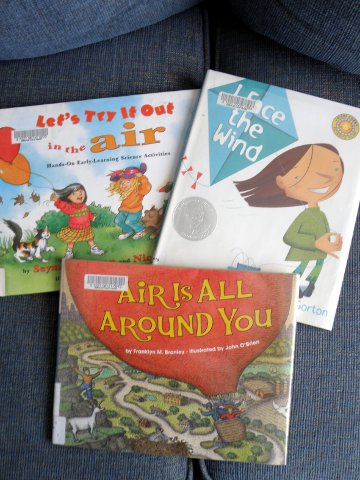
So, for example when learning about matter, one lesson was all about understanding that air is matter. There was a book list at the end. Here are three of the books we read. I find the books recommended are rich in information and not boring. In many cases there are experiments in them for the kids to do and we do the experiments as we read along. If Zoe gets bored or isn't interested she is allowed to leave the room and go do her own thing.

Keep in mind Austyn does experiments of different kinds on his own as he gets ideas and he loves to study nature. Interest led (unschooling) doesn't mean that he never learns anything out of his own experiences. I believe that the more he has access to the better. Facilitating a rich environment and setting up activities that he loves naturally in our home is a great way to expand his knowledge without dictating what he has to learn or when he has to learn it and if anything seems unenjoyable we just don't continue (hasn't happened yet with doing it this way). This approach seems to work here. I know that Austyn loves science and he loves doing most of his subjects this way especially when he has run out of things to do on his own. I may get the books as a way of facilitating his learning but through the books he feels in control of his own learning by insisting on doing the experiments and initiating related conversations on his own.

Wednesday, February 9, 2011

Book Review - Radical Unschooling

This book may be short, but it is full of useful reminders and positive inspiration. Dayna Martin really knows how to make a parent-in-transition feel good, even when there are set-backs. I recommend this to others who are switching from a more traditional way of parenting to a much more gentle, loving parenting style (which is what radical unschooling is all about). This book also touches on spiritual (not to be confused with religious) ways of thinking, just like many other unschooling books do. It was a refreshing reminder for me.

One important piece of information that I learned and have to be aware of is that unschoolers (especially those new to it and may not truly understand how it's done) could get homeschool burnout! Yes! Burnout! I can relate to this. I think that being new to this homeschooling philosophy we sometimes assume as parents that what it is all about is meeting the needs of our children but we might think that means ignoring our own needs. I find that sometimes the work involved in facilitating the education for my children seems like more work than if I`m just following a curriculum. I need to think creatively and come up with things to do on the fly. I know that if they ask for something that I don`t feel like doing I can find ways to peacefully meet both my needs and theirs.

This book also touches on Dads in unschooling and how to be patient with them as they go through the transition. Basically, from what I understand, in an unschooling lifestyle we treat everyone in our lives the same way... with respect and love, no matter what.

Tuesday, June 29, 2010

Book Review - The Unprocessed Child

I just finished reading The Unprocessed Child by Valerie Fitzenreiter. All I have to say is “WOW!” It wasn't an easy book to get my hands on, but it was well worth it! 

I’m not sure exactly why, but for some reason I couldn’t put this book down. I knew as soon as I read the forward, which was written by the authors’ daughter who was unschooled, that I’d have to read this book right away and put anything else that I was reading aside until I was done. 

The author shares her experiences bringing up her daughter without teaching her. The book is broken up into small chapters so reading each chapter was fast (this is probably part of the reason I couldn’t put it down since I kept saying that I could just read one more chapter). Her opinions about how children should be brought up seem like common sense but for some reason many people (me included for some things) follow what is expected through society and don’t actually consider what kind of effect it’ll have on their child, their relationship with the child and the harmony of the home. After much research and taking a parenting course a couple of years ago we have already been moving away from punishments in our home. Reading her opinions and experiences were so interesting to me and gave me so much enlightenment and courage when I needed it. 

Some of the stories are humorous which makes the book that much better. I was laughing out loud. There is so much food for thought in her words. If you are considering unschooling but are afraid to do it you NEED to read this book!

Wednesday, June 23, 2010

A new friend dropped this book off for me to read along with another unschooling book that I've already posted about. I finally finished this one. It was an excellent book. I understand unschooling much better now. Learning it right from one of the most inspirational and well-known authors in the unschooling movement really sheds some light on what this movement really is. I was particularly interested in the ways to introduce different subjects to kids without teaching. From what I understand our math program (that we follow very relaxed as it is) is directly in-line with how it is suggested to be introduced to children in this book. We follow RightStart Math. It's a very hands-on, self-discovering approach to math, with little to no memorization and very few work pages. 

The more I read the more I see just how much I need to deschool myself and think about my children differently than what is expected in our schooled society. I would like to meet more unschooled families, especially those with older children to get an idea of how differently they go about learning. There are only a few families that I know of in this area and most of them are very young. I recommend this book to anyone who has young children. I find so much truth here and wonder how society has affected my personal actions and beliefs in so many ways without any real logic. This type of learning makes so much sense to me, but I find it hard to stop my compulsion to teach. This would be a nice book to have around for a resource when things don't seem to be going well for my kids. I can figure out what I am doing and what I can change about my actions to help them learn more efficiently.

Tuesday, June 22, 2010

Curiosity Club - Learning about birds


We are learning about birds right now in The Curiosity Club. We have been reading about birds in the book and in other books we've chosen. We've been watching the behaviour of birds in our own backyard. Austyn has a curiosity for humming birds so I downloaded a lap book that I'll post another time. I also downloaded another "My Favourite" lap book, which I'll also share later. For this post I'll focus on The Curiosity Club. I really love this book because it seems to be short interesting reads throughout. The activities include other subjects and are fun. There are many visuals in the book that help to explain what is being learned.

Here we did a mystery drawing. I gave the instructions on the white board. One instruction at a time, waiting for them to finish each step on their drawing pads. Then they guessed what they drew. This also helped to understand the make-up of feathers.

Here are their drawings. Austyn's is on the left and Zoe's is on the right. She restarted a couple of times on the first step so her final feather is at the bottom right of her page. 

We did an experiment with paper to learn how birds fly and after the kids decorated their piece of paper. 


We learned about different kinds of feathers. Feathers that come from different kinds of birds and feathers that are located on different parts of the bird and their special names. Then we looked closely at the feathers we had around the house including our craft feathers and discussed what bird they likely came from and what part of the bird the feathers were from. After that the kids experimented with the sound the feathers made when whooshed through the air. That lead into trying to use them to fly. So here is Austyn trying to fly with only one feather in each hand. Zoe is trying to fly with many feathers.

Sunday, June 6, 2010

Book Review - Deschooling Our Lives


Thanks to a new friend, who dropped this book off for me to read, I had the opportunity to peek into lives of many people who choose to learn without school as we know it. There are so many interesting views and ways for children to learn. I have been awakened further with the realization of how we (people) tend to follow society and just comply, ignorant to why we do what we do in the first place. In our current school system and our current schooled state we tend to prevent kids from reaching their potential. I can honestly say that in my life I've learned more in my adult life (following my own interests) than I did in school. So why wouldn't I want that kind of enthusiasm and efficiency in my children throughout their lives?  Through reading this book I have learned where the current ways of public schooling came from. I now realize how our parenting decisions sometimes affect how my kids learn. I recommend this book for EVERYONE. I think that we all need to know that there are other ways of learning (even if we don't intend to practice them in our homes) and of looking at our world. We need to evolve instead of being safe and changeless in our current society. 

I absolutely love to see the world in different views. I believe that it pushes my own beliefs and just makes me a better, more open minded person. I will be giving this one five stars when I review it online.

Thursday, May 27, 2010

Two Sides to Every Story!

The great thing about my kids is that they really do love to read! And one thing about that is that I can organize books so that we can learn life lessons through books. We can read two sides to the story or different versions of a story to do a little bit of critical thinking and come up with our own understanding about that story. Here is an example of this.

Today we listened to a CD and read the book of The Three Little Pigs. After it was finished I talked about how there are many versions of The Three Little Pigs and why that might be. I gave some examples of the different versions I can remember from our reading and from my own childhood. 

After that we read this book. The True Story of The 3 Little Pigs! by Jon Scieszka is a story of the Three Little Pigs from the Wolfs' point of view. It's a different story all together and we can see after reading the first book how some of the things that occurred in the story could have been taken differently.

Once finished, we talked about how they were different stories and how the Wolf could have been correct about how the story could have been twisted around to make him look like the Big Bad Wolf. And we talked about how sometimes when we read something, see something on T.V. or get told something by people around us we might want to make a judgment right away. We talked about how there are usually many sides to one story and that it's not fair to judge someone, because no matter what there could always be more to the story than what we see or are told.


Tuesday, May 18, 2010

Rediscovering a Book!


While sorting through our home library I found a book that seems to fit perfectly for us this summer. It's a book that I picked up at a used book sale and we've not used it yet. I was flipping through and it seems to be something that would work well for us right now. 

It's all about nature. It's packed full of nice quick reads and activities. The book is nicely broken up into usable subject groups. Here is the list of subjects broken down in chapters. I think we may do the subjects out of order. We'll just choose what makes sense for us to study first.

Here are the Contents:

Chapter 1
Trees

Chapter 2
Green Plants

Chapter 3
Soil

Chapter 4
Animals

Chapter 5
Birds

Chapter 6
Insects and Spiders

Chapter 7
Weather 

I am a bit excited about this book and our activities. I can't wait to share some of them with you here as we study nature in our neighbourhood.

Tuesday, March 2, 2010

Raising Our Children, Raising Ourselves


This is, BY FAR, the best parenting book I've EVER read! I was told about it by a friend and have finally read it. I first must say that I was impressed after purchasing it to read that the authors mentioned in the beginning of the book who had influence to it's contents. Many of them follow along the same ideas and values that I do and for me that was so amazing because it's hard to find content for my kids that follow my beliefs. Many of the authors mentioned I've read books from. There are aspects of the book as I read that I can see how "being present" and following "the flow" of the child and there are definite unschooling references. 

I catch myself before reacting most of the time and do my best to separate myself from the situation so that I can respond to the needs of my kids. We are still working on some issues we are having but I know that sometimes these things take time. I am also not as hard on myself as I've been in the past. I find with other books I'd give up on reading them because I'd be so hard on myself, but this time I'm different. I'm sure that may have something to do with all of the other reading I've been doing, but it still has something to do with this book. I am going to have to read it again in a couple of months. The information in it is so different to what society says or what I was brought up to do.

It is a plan for parents to bring up children with respect and without punishment or rewards. Through her plan that she calls S.A.L.V.E. I've found that I'm going deeper into myself and learning why I react the way I do with my kids and how it isn't them at all. Kids mean well and only end up not meaning well when they've been taken the wrong way for too long and become desperate or feel insecure. I am going through a healing process and dealing with past experiences just through the process that I am going through with my kids. I'm learning so much about me and about them. It is just an extension of what I've been learning about already and the timing couldn't be better. 

The other great thing is that the skills learned in this book can also be used with other relationships (work, spouse, friends etc.) I used S.A.L.V.E. when having a disagreement with my husband this weekend and the pain body that came up from my past actually brought tears to my eyes for a moment. We got through it fine and I think that by sharing my "S" from S.A.L.V.E. experiences with him helped him to see what I was going through. I also asked him important questions that he could walk away with and think about within himself. 

Through the plan in this book the children and parents become healed from old hurts and learn to live together in the now (presence), in harmony, and with love. The other important thing here is that although there is a deep attachment built through Attachment parenting practices (CoSleeping etc.) the child learns detachment with his/her feelings. What I mean by this is that the child sees that his/her parents or a sibling didn't cause the feelings but that the feelings are owned by the child and that it's okay to feel. There are tips to get the child through the feelings okay so that they can move on. There are many examples, ideas, and tips throughout the book for many different scenarios. What a great book! 

"There is no right or wrong behaviour. The only meaningful choice is between fear and love." ~ Gerald Jampolsky, Ph.D (as quoted in the book)

Tuesday, January 12, 2010

Growing Green Kids

Every once and a while I research different books on different subjects. I've been doing this more the past couple of months because we've changed direction in the way we homeschool. I'm looking for alternatives to the traditional (sit down) school work scenario. Here are a couple of books I found with fun activities for bringing up kids who are aware of the environment. I borrowed them both from the library but I now want them to keep here at home.


The first one is "Grow Your Own Tree Hugger by Wendy Rosenoff". It is a book full of activities to do with great photography illustrating each activity. Here is the chapter break-down.

Section 1: The Lab Report - Science Projects
Chapter 1: Chemical-Free Zone
Chapter 2: Grow Organic and Eat Local
Chapter 3: Reduce, Reuse and Recycle
Chapter 4: Alternative Energy
Chatper 5: Save our Natural Resources
Chapter 6: Endangered Species
Chapter 7: Sustainable Living
Section 2: The Kitchen Sink - Food Projects
Chapter 8: Chemical-Free Zone
Chapter 9: Grow Organic and Eat Local
Chapter 10: Fair Trade
Chapter 11: Alternative Energy
Chapter 12: Save our Natural Resources
Chapter 13: Endangered Species
Chapter 14: Sustainable Living
Section 3: The Studio Gallery - Craft Projects
Chapter 15: Chemical-Free Zone
Chapter 16: Grow Organic and Eat Local
Chapter 17: Reduce, Reuse and Recycle
Chapter 18: Alternative Energy
Chapter 19: Save Our Natural Resources
Chapter 20:  Sustainable Living


Here is the other book: "i love dirt! 52 activities to help you and your kids discover the wonders of nature, by Jennifer Ward". This book is full of activities to do outside, in nature. The sections are set up by seasons. This one seems more appropriate for my kids. The activities seem like they are meant for younger children or at least activities that could be shared with different ages at once. They are all fun activities but with underlying lessons. This book is set up in a smaller version that could be brought into the trees easier than a larger book.

Both books were great finds. Each one had a purpose and I believe they are both worthy of being on the bookshelf of our home library.